
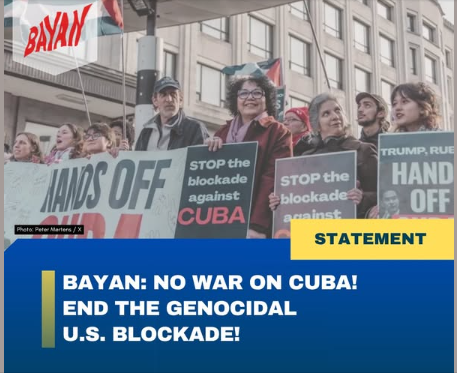
Bagong Alyansang Makabayan (BAYAN) – Statement
June 1 at 10:38 PM
From the Treaty of Paris to Revolution and Sovereignty
Like the Philippines, Cuba emerged from the wreckage of the 1898 Treaty of Paris, when a declining Spanish empire handed over colonized peoples to an ascendant U.S. imperial power. Yet while the Filipino people’s anti-colonial revolution confronted violent U.S. conquest and the imposition of a neocolonial order sustained by comprador elites and political dynasties, generations of Filipinos continued to resist—through anti-imperialist, peasant, workers’, Moro, and revolutionary movements that refused capitulation. Cuba’s victorious revolution of 1959 represents not a distant exception, but a living affirmation of what oppressed peoples continue to struggle for.
Under the leadership of Fidel Castro, the July 26 Movement, and generations of revolutionaries, Cuba transformed from a neocolonial appendage of U.S. capital into a sovereign socialist nation committed to human dignity, social welfare, and international solidarity. Today, the Cuban Revolution remains a living rebuke to imperialism: proof that another social order—one based on people’s welfare rather than profit and elite plunder—is possible.
What the United States Is Punishing Cuba For
The United States claims to defend “democracy” while subjecting Cuba to over six decades of siege, sabotage, sanctions, destabilization, and economic warfare. The cruel and illegal blockade—now intensified into an energy embargo that Cuban leaders correctly describe as an act of war—aims to starve the Cuban people into submission.
This punishment is not imposed because Cuba has failed. Cuba is punished precisely because it succeeded in proving that even under relentless attack, a poor and formerly dependent nation can prioritize human needs.
Cuba built universal and free healthcare, free education at all levels, scientific research, cultural development, food security systems, and social indicators that rival wealthy capitalist states. It eradicated illiteracy, dramatically lowered infant mortality, expanded life expectancy, and guaranteed social rights unimaginable for millions living under neoliberal capitalism.
Even amid intensified blockade, Cuba developed its own COVID-19 vaccines, trained doctors, sustained universal public healthcare, and continued investing in renewable energy and public welfare despite shortages deliberately imposed by U.S. aggression.
Cuba’s Revolutionary Internationalism
Cuba never hoarded its achievements for itself. It extended solidarity wherever peoples struggled against colonialism, racism, disease, and exploitation.
Cuba supported liberation struggles across Africa, including Angola, Guinea-Bissau, and Namibia, and contributed materially to the defeat of apartheid in Southern Africa. It sent doctors—not bombs—to countries in need, from Algeria to West Africa during Ebola, from Latin America to Europe during the pandemic.
Its medical brigades have cared for millions in neglected communities abandoned by profit-driven healthcare systems. Through the Latin American School of Medicine (ELAM), Cuba trained thousands of doctors from poor and marginalized communities worldwide—including from the United States itself—who returned home to serve working people. Cuba taught literacy across the Global South and restored sight to millions through Operation Miracle.
While imperialism exports war, Cuba exports solidarity.
Fidel Castro and the Endurance of the Revolution
That Fidel Castro survived more than six hundred documented assassination plots and yet died of natural causes stands as testament not only to his extraordinary leadership, but to the steadfast loyalty and vigilance of the Cuban people in defense of their Revolution. Today, even after Fidel’s passing, imperialism continues its campaign of destabilization and historical erasure. The recent decision of the United States to file charges against former Cuban President and revolutionary leader Raúl Castro over the 1996 downing of aircraft linked to anti-Castro exile operations is not merely a legal maneuver—it is part of an information war aimed at discrediting a leader who helped preserve the socialist path during one of Cuba’s most difficult transitions following Fidel’s death. The charges emerge amid renewed U.S. escalation against Cuba and function as a warning against sovereign defiance.
This pattern is painfully familiar. Across colonies and semi-colonies, leaders who dared to assert national sovereignty and resist imperial domination have been demonized, overthrown, assassinated, or criminalized: Patrice Lumumba, whose assassination occurred with documented Belgian involvement and longstanding evidence of CIA complicity; Thomas Sankara, the revolutionary leader of Burkina Faso assassinated in a coup long associated with reactionary and foreign interests hostile to his anti-imperialist program; Salvador Allende, overthrown in a U.S.-backed coup; and Muammar Gaddafi, whose state was destroyed through NATO intervention. Today, the brazen U.S. abduction and prosecution of Venezuelan President Nicolás Maduro reveals that imperial punishment against governments that refuse subordination remains very much alive.
Yet Cuba endures. Despite hardship, shortages, blackouts, and intensified sanctions, the Cuban people continue to defend socialism with remarkable resilience, creativity, and collective sacrifice. Through mass participation, solidarity, and the revolutionary principle of the “War of All the People”, Cuba has affirmed that sovereignty belongs to both governments and organized peoples prepared to defend their future.
The Philippine State and the Costs of Neocolonial Rule
The Filipino people know all too well the devastating costs of neocolonialism.
While Cuba defended sovereignty and built social welfare, successive Philippine regimes remained subservient to U.S. imperial dictates—trading national development for debt, militarization, and elite enrichment. Acting as willing instruments of neocolonial rule, Philippine comprador and puppet governments deepened neocolonialism while abandoning millions to poverty, privatized healthcare and education, mass unemployment, hunger, and labor export.
Working poor Filipinos know what is absent in our society: children forced into the streets, inaccessible medicine, underfunded schools, privatized hospitals, and livelihoods sacrificed for elite profit.
Many Filipinos aspire to the kind of social guarantees Cuba fought to build—a society where healthcare and education are rights, not commodities; where children are not abandoned to homelessness; where science serves public welfare; where development is planned for people rather than foreign investors and oligarchs.
Yet instead of pursuing genuine sovereignty and social transformation, successive puppet regimes in the Philippines have intensified militarization and fascist repression in service of imperial interests.
Under U.S.-directed counterinsurgency frameworks, the Filipino people confront extrajudicial killings, enforced disappearances, terrorist-tagging, red-tagging, political persecution, militarized communities, and draconian laws weaponized against dissent and mass democratic organizing. These are not signs of a strong democracy but symptoms of a neocolonial state fearful of its own people’s aspirations for justice, sovereignty, and meaningful social transformation.
It is precisely because Cuba demonstrated what national sovereignty, mass participation, and people-centered development can achieve that it remains under relentless attack. And it is precisely why progressive, democratic, and anti-imperialist forces in the Philippines continue to defend Cuba—as both an act of international solidarity and an affirmation that another future remains possible.
Imperialist War, the Monroe Doctrine, and the Indo-Pacific War Machine
The renewed aggression against Cuba forms part of a broader imperial strategy.
As Washington reasserts the Monroe Doctrine in Latin America—seeking to neutralize sovereign development projects and punish governments unwilling to submit—it simultaneously expands war preparations in Asia under the manufactured framework of the so-called “Indo-Pacific.”
The Philippines has become a frontline staging ground for U.S. military escalation against China through expanded military bases, war exercises, weapons stockpiling, and foreign troop access. Just as Cuba faces siege in the Caribbean, peoples across Asia are being drawn into dangerous camps for imperial confrontation.
BAYAN rejects this militarization. The Filipino people must not be used as cannon fodder in imperial rivalries while social services collapse and democratic rights are suppressed.
Cuba Is Not Alone
The people of the Philippines know what it means to endure imperial domination, fascist violence, and elite rule. We therefore stand firmly with the Cuban people as they resist economic warfare, military threats, disinformation, and renewed aggression.
The movement for national liberation, democracy, and socialism in the Philippines recognizes Cuba not as an abstraction, but as living proof that oppressed peoples can defend sovereignty and organize society around human need.
We defend Cuba because defending Cuba means defending the possibility of a just future.
BAYAN calls on the Filipino people and the international community to:
Condemn all U.S. threats of military aggression against Cuba;
Demand an immediate end to the genocidal economic and energy blockade;
Oppose the reassertion of the Monroe Doctrine and all forms of imperial intervention in Latin America and the Caribbean;
Reject the militarization of the Philippines and U.S. war preparations in the so-called Indo-Pacific;
Strengthen anti-imperialist solidarity among peoples resisting fascism, militarism, and imperial domination;
Support Cuba’s sovereign right to socialism, self-determination, and national development free from coercion and aggression.
No war on Cuba!
End the genocidal U.S. blockade!
Hands off Cuba!
Reject U.S. militarism from Latin America to the Asia-Pacific!
Long live international anti-imperialist solidarity!