Category Archives: Uncategorized

Joma terror delisting, free land distribution among agreements in third round of talks

Kodao Productions
January 25, 2017

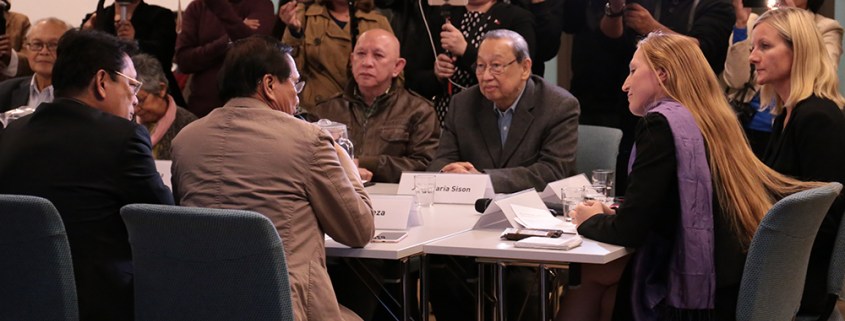
 ROME, Italy—The National Democratic Front of the Philippines (NDFP) and government negotiators are set to end their third round of formal talks today on a successful note with advances on the substantive agenda and new goodwill measures included in the prospective Rome Joint Statement.

NDFP chief negotiator Fidel Agcaoili and his Government of the Republic of the Philippines (GRP) counterpart Silvestre Bello III said their joint statement will include the signing of the supplemental guidelines on the Joint Monitoring Committee as well as agreements on the ground rules for future negotiations on socio-economic and political and constitutional reforms.

They also agreed to hold a special meeting in The Netherlands in February 22 or 24 to discuss the GRP proposal for a bilateral ceasefire. In the said meeting, Bello will also witness NDFP’s submission of its reconstituted list of Joint Agreement on Safety and Immunity Guarantees-protected persons with Archbishop Wim Eijk of Utrecht for safekeeping.

“This round is turning out to be a success, despite the apparent sabotage with the killing of the activists in Negros Occidental and Surigao del Norte and the attack on the NPA (New People’s Army) encampment in North Cotabato,” Agcaoili said.

Joma Sison delisting

Bello for his part revealed that the joint statement shall include a request to the United States of America (USA) that NDFP chief political consultant Jose Maria Sison be delisted from its terror list.

“We have a basis (for such request), considering he is in the process, the peace talks, which negates the character of a terrorist,” Bello said.

Bello said it is important for Sison to be able to travel outside of Europe in response to GRP President Rodrigo Duterte’s statement he is willing to meet his former professor in any neutral Asian country.

NDFP panel member Benito Tiamzon and consultant Wilma Austria welcomed the move saying it would help in the negotiations.

“We have long been saying that the revolutionary movement, the Communist Party of the Philippines, the NPA, most especially Prof. Sison are not terrorists,” Tiamzon said.

“It is also important that President Duterte is saying he is independent of the US and this is one concrete step showing he really is independent,” Tiamzon added.

Sison has yet to issue a statement on the development.

Painstaking SER negotiations

NDFP socio-economic reforms Reciprocal Working Committee (RWC) spokesperson and agrarian and rural development focal person Randall Echanis said their bilateral meetings with their GRP counterparts have taken a few steps forward.

“For the first time, the GRP has submitted a comprehensive draft and we have agreed that both our drafts would be discussed with a matrix comparing both versions,” Echanis said.

Echanis also said that the Preamble and Declaration of Principles mostly based on the NDFP draft has already been agreed upon by the Reciprocal Workings Committees (RWC).

“We have identified commonalities on the Bases, Scope and Applicability provisions of our respective drafts and these are three important parts that our bilateral negotiations have disposed with,” Echanis said.

Echanis also revealed that the GRP has agreed in principle that there should be free land distribution to farmers, subject to consultations with other government agencies.

“We are for free land distribution while the GRP is for land distribution at least cost to the farmers. We met halfway by saying the compensation should not come from the farmers but from the government,” he said.

“They said the NDFP draft’s use of the word of ‘confiscation’ is unconstitutional. We clarified that land grabbed with use of violence and intimidation should be confiscated without compensation but we have no question with just compensation for landlords whose land was accumulated through just means,” Echanis clarified.

Echanis said the NDFP had been meeting GRP halfway in their negotiations as long as the essence and principle of agrarian reform is not compromised.

The closing ceremony of the third round is expected to be held at three o’clock local time (nine o’clock in the evening, Philippine time).

The fourth round of NDFP-GRP formal peace talks shall be held in April in Oslo, Norway. # (Raymund B. Villanueva)

xxxxx
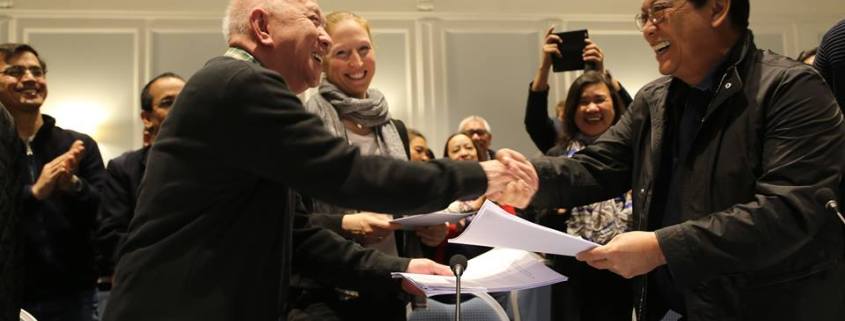
‘First achievement of the 3rd round’: Parties sign supplemental guidelines of Joint Monitoring Committee

Kodao Productions
January 21, 2017

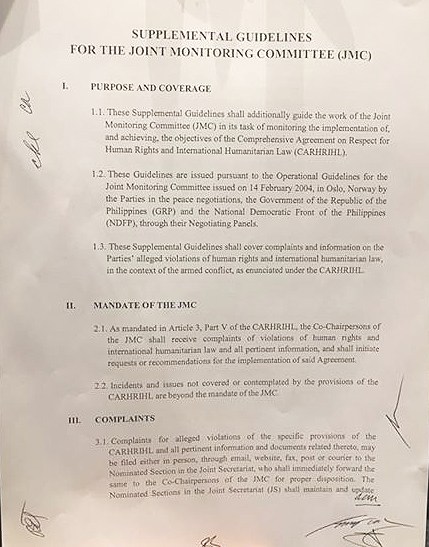
ROME, Italy—The National Democratic Front of the Philippines (NDFP) and the Government of the Republic of the Philippines (GRP) signed the supplemental guidelines to the Joint Monitoring Committee (JMC) of the Comprehensive Agreement on Respect for Human Rights and International Humanitarian Law (CARHRIHL) on the third day of their third round of talks.

Marking the first big achievement of the parties’ negotiations in this city, the agreement pushes forward the joint nature of monitoring and upholding human rights in the Philippines, NDFP negotiating panel chairperson Fidel Agcaoili said.

“Finally now under President (Rodrigo) Duterte, we made the determination to sign the supplemental guidelines that will now govern the operation of the JMC as well as its Joint Secretariat,” Agcaoili said.

GRP negotiating panel chairperson Silvestre Bello III for his part said he is glad that the CARHRIHL can now come into fruition, the first substantive agreement he negotiated and signed with the NDFP in 1998.

The signing of the guidelines is “a concrete dividend of this round of talks,” Bello said.

“The full operation of the JMC with its supplemental guidelines in place should not be difficult under our legal regime that included new and bold laws and statutes upholding human rights and international humanitarian laws (IHL), such as the law against enforced disappearance, anti-torture act, IHL ACT, human security act, Writ of Amparo and the Writ of Kalikasan, among others,” Bello added.

“These Supplemental Guidelines shall additionally guide the work of the JMC in its task of monitoring the implementation of, and achieving the objectives of the CARHRIHL,” the newly-signed document said in its purpose and coverage provisions.

“These Supplemental Guidelines shall cover complaints and information on the Parties’ alleged violations of human rights and international humanitarian law, in the context of the armed conflict, as enunciated under the CARHRIHL,” the agreement said.

The JMC was formed and was made operational at the first two rounds of formal peace negotiations between the NDFP and the Gloria Macapagal Arroyo administration in Oslo, Norway on February 10-14 and March 30 to April 2, 2004.

Its formation was in accordance with the CARHRIHL which became effective in August 7, 1998 after it has been signed by NDFP Chairperson Mariano Orosa and GRP President Joseph Estrada.

The JMC then opened its Joint Secretariat (JS) on June 4, 2004 which has since received more than six thousand reports of human rights violations against both the GRP and the NDFP, with the former getting majority of the complaints.

As of May 23, 2016, the NDFP-Nominated Section of the JS received 4,471 complaints against the GRP and 1,926 against the NDFP.

The NDFP however said that 96 per cent of the complaints against them are “nuisance complaints” filed wholesale last November 8, 2006 by the Judge Advocate General’s Service of the Armed Forces of the Philippines.

Most complaints against the GRP and its forces on the other hand were filed by human rights organizations or directly submitted by the victims or their families.

The JMC has never conducted joint activities, particularly in processing and investigating complaints of human rights violations received by both parties, as in the murder of the late NDFP consultant Sotero Llamas.

The signing of the supplemental guidelines in the ongoing round of talks has launched the JMC into full operation for the joint activities, the parties said.# (Raymund B. Villanueva)

 xxxxx

Unilateral ceasefire untenable; bilateral ceasefire prospects dim–NDFP

Kodao Productions
January 18, 2017

ROME, Italy–The National Democratic Front of the Philippines (NDFP) submitted a long list of complaints against the Government of the Republic of the Philippines (GRP) for violations of previously-signed agreements which, it said, make the extension of its unilateral ceasefire untenable.

Even as delegates from both parties are starting to fill Holiday Inn-Parco de Medici (venue of the January 19-25 talks in this city) the Left’s negotiating panel formally raised with its counterpart seven GRP violations of the Comprehensive Agreement on Respect for Human Rights and International Humanitarian Law (CARHRIHL) and the Joint Agreement on Safety and Immunity Guarantees (JASIG)

“The prospect for forging a bilateral ceasefire agreement has grown dim,” NDFP chief negotiator Fidel Agcaoili in a statement said.

The NDFP Negotiating Panel cited the following cases:

  • Betrayal of the Left’s trust through GRP’s request to the NDFP to withdraw the judicial appeals of three JASIG-protected NDFP consultants that eventually made their conviction final. But GRP President Rodrigo Duterte has yet to pardon Eduardo Sarmiento, Emeterio Antalan and Leopoldo Caloza to enable them to participate in the ongoing GRP-NDFP peace negotiations;

  • The surveillance and harassment by motorcycle-riding men of recently released JASIG-protected consultants;

  • GRP’s failure to act on NDFP’s demand for justice for the enforced disappearance of JASIG-protected persons Leo Velasco, Prudencio Calubid, his wife and relatives; Rogelio Calubad and his son; Nestor Entice and his wife; Leopoldo Ancheta; and Philip Limjoco; as well as the murder of Sotero Llamas that were all committed during the time of President Gloria Macapagal-Arroyo;

  • The ongoing Armed Forces of the Philippines operations against communities suspected to be under the control of NDFP forces on the pretext of conducting so-called peace and development projects. The NDFP has listed such violations in 43 provinces and 146 municipalities all over the country;

  • The killing of innocent people due to brutal, reckless and indiscriminate methods employed by the police in its anti-drug operations;

  • Failure of President Duterte to amnesty close to 400 political prisoners as he repeatedly promised since May; and

  • GRP’s failure to render justice and indemnify victims of human rights violations under the Marcos martial law regime, in addition to its attempt at the political rehabilitation of the Marcoses through the late dictator’s burial at the Libingan ng mga Bayani.

“These violations place into serious question the sincerity of the GRP in its peace negotiations,” Agcaoili explained.

“For if previously signed agreements are not honored, what guarantees does the NDFP have that future agreements would not be similarly violated by the GRP?” he asked.

The GRP has not made secret its desire to forge a bilateral ceasefire agreement as one of the major issues to be discussed in the third round of talks.

“The third round of talks hopes to tackle the still unfinished discussions on the proposed bilateral ceasefire vis-à-vis the issues on the releases of prisoners,” Presidential Adviser on the Peace Process Jesus Dureza in an earlier statement said. # (Raymund B. Villanueva)

 xxxxx
Bello: President Duterte will honor promise to free all political prisoners

By ANTONIO L. COLINA IV – DECEMBER 27, 2016

DAVAO CITY (MindaNews/27 December) – Labor Secretary Silvestre Bello III on Monday said he does not doubt that President Duterte would fulfill his promise to release all political prisoners as part of the peace negotiation with the National Democratic Front.

Bello, also the chair of the government peace panel in talks with the NDF, issued the statement in Paquibato District here where he attended the 48th founding anniversary celebration of the Communist Party of the Philippines.

“President Duterte has given word that he will release all political prisoners, and I don’t doubt his word,” he said in Filipino.

20161226-bellosueno

Local Government Secretary Mike Sueno and Labor Secretary Silvestre Bello III attend the 48th founding anniversary celebration of the Communist Party of the Philippines in the hinterland village of Lumiad in Paquibato District, Davao City on Monday, December 26. Mindanews Photo

He added the GRP panel was working on the release of 17 to 20 political detainees before the year ends.

Around 50 to 70 detainees were earlier promised to be released in time for the International Human Rights Day last December 10.

Bello explained the release has been delayed by the need to follow judicial processes.

He said it would have been easier if the political prisoners were already convicted by final judgment because the President can just pardon them.

“Meron iba kasi may (The others have) pending case against them, so the cases are pending in court. So it will be the court who will decide if they will be given temporary liberty,” he said.

“Ang pangako ng president na palalayain nya lahat pero dadaan sa (The President promised to free all but they have to go through a) legal process. And besides, may sinabi si Presidente na (the President said) he is willing to declare a general amnesty subject to the approval of the Congress. I think this will be an act of the President after a final peace agreement has been signed,” he said.

Last December 6, a statement from the Office of the Presidential Adviser on the Peace Process quoted Duterte as saying there will be no substantial release of political prisoners unless the two parties signed a bilateral ceasefire agreement.

“Produce to me a signed bilateral ceasefire agreement and I will release them within 48 hours. You can take my word for it,” Duterte said.

The President said he would lose all his cards if he releases all political prisoners while still in the thick of negotiations.

But this did not sit well with the communists who said Duterte likened the release to a card game to force the NDFP to enter into a bilateral ceasefire agreement.

Connie Ledesma, a member of the NDF peace panel, alleged that government troops continued to violate the unilateral ceasefire declaration issued in August by Duterte.

She said there has been a clamor within the CPP to lift its unilateral ceasefire declaration.

But Bello said that they have not received reports of the alleged violations.

He said complaints should be addressed to the GRP peace panel, Commission on Human Rights and Department of Justice.

The GRP and NDFP panels will resume the third round of peace negotiations in Rome, Italy on January 18 to 25 to flesh out the Comprehensive Agreement on Socioeconomic Reforms (CASER).

The CASER, described as the “heart and soul” of the peace negotiations, contains the most contentious issues such as agrarian reform, national industrialization, and foreign policy.

(Antonio L. Colina IV/MindaNews)

xxxxx

IN UNITY WITH THE CPP’S CALL FOR PEOPLE’S EXPRESSION OF INDIGNATION OVER DUTERTE’S UNFULFILLED PROMISES IN PEACE NEGOTIATIONS

20161226-cpp-anniv120161226-cpp-anniv2

By Jose Maria Sison
Founding Chairman, Communist Party of the Philippines
Chief Political Consultant, National Democratic Front of the Philippines
December 26, 2016

Dear Comrades and Friends,

Let me first give the Red salute and warmest revolutionary greetings to the Communist Party of the Philippines, the New People’s Army, the National Democratic Front of the Philippines, the local organs of people’s democratic government and the broad masses of the people on the occasion of the 48th anniversary of the reestablishment of the CPP under the theoretical guidance of Marxism-Leninism-Maoism.

This is a day of celebrating the accumulated and recent victories of the Party, the people’s army and the people in the new democratic revolution through protracted people’s war. This is also the day for the people to manifest their indignation over the Duterte regime’s failure to fulfill its promises in the peace negotiations, especially the amnesty and release of all political prisoners listed by the NDFP in compliance with the Joint Agreement on Safety and Immunity Guarantees (JASIG) and the Comprehensive Agreement on Respect for Human Rights and International Humanitarian Law and in consonance with a possible bilateral interim ceasefire agreement and the plan to accelerate the peace negotiations.

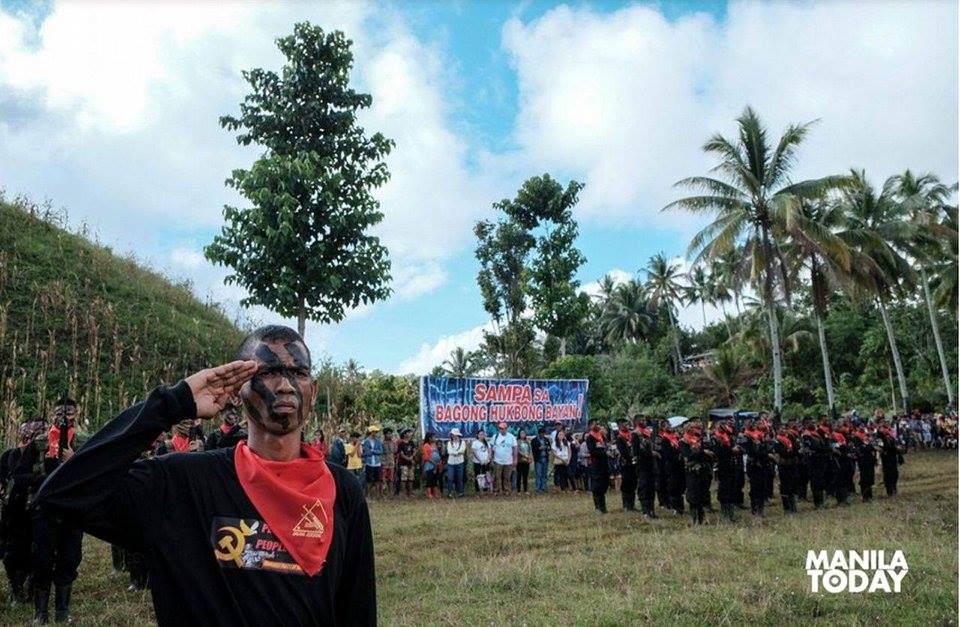
This is the day for peace rallies nationwide to demonstrate the Filipino people’s unity for a just and lasting peace. In this regard, a national assembly is held in a guerrilla zone somewhere in Davao City. All sectors of society that are desirous of a just and lasting peace are expected to join the peaceful actions under conditions of the reciprocal unilateral ceasefire declarations. Representatives of the Duterte regime have also been invited to attend in order to hear for themselves the people’s outcry for justice. We make complaints and constructive criticism in the hope of obtaining positive results for the benefit of the people.

We have no other objective but to demand the amnesty and release all political prisoners and give way to a bilateral ceasefire agreement. These matters can be settled in a few number of hours. We should not get stuck on such matters by dealing with them piecemeal over a long period of time. We can make a stable bilateral ceasefire agreement by learning lessons from the period of unilateral ceasefire declarations. Oplan Bayanihan should be terminated and should not be replaced by another brutal oplan under General Año, who kidnapped Jonas Burgos. Safe distances must be kept between the armed forces and units of the GRP and the NDFP by restricting them to barracks at battalion or higher level in the case of the AFP or areas of encampment in the case of the NPA at company level.

The GRP and NDFP negotiating panels should finish and sign the comprehensive agreements on social and economic reforms, political and constitutional reforms and end of hostilities and disposition of forces within the first or second year of the Duterte regime and there will be at least three or four years to observe the implementation of the agreements on basic reforms and allow the cooperation of the cadres, Red fighters and revolutionary forces with the regime in the social, economic, cultural, political and security system of a truly independent, democratic, progressive and prosperous Philippines.

The main interest of the NDFP and the People´s Revolutionary Government in social and economic reforms is economic development through national industrialization and genuine land reform. Also, their main interest in political and constitutional reforms is upholding national sovereignty and democratic principles. They are also willing to co-found the Federal Republic of the Philippines with the Duterte regime and make a new constitution that prevents fascist dictatorship, political dynasties, warlordism and dissipation of national resources.

We should welcome the third round of formal talks to be held between the GRP and NDFP negotiating panels in Rome from January 19 to 24, 2017. The Reciprocal Working Committee of the NDFP will be going to these talks with its 84-page proposed draft of the Comprehensive Agreement on Social and Economic Reforms (CASER). The Reciprocal Working Group of the NDFP on Political and Constitutional Reforms will be ready with a rough draft of at least 20 pages of the Comprehensive Agreement on Political and Constitutional Reforms (CAPCR). The Reciprocal Working Group of the NDFP on End of Hostilities and Disposition of Forces (RWG-EHDF) will be observing the talks to gain insight for drafting its assigned comprehensive agreement.

The prospects are still bright in the GRP-NDFP peace negotiations if we consider that the rounds of talks are proceeding successfully. The discussion on CASER and on other matters can certainly progress during the third round of formal peace negotiations. It would be alright for the talks in Rome to schedule the fourth round in a neutral venue. The two sides can meet to talk whatever is the status of the talks on the bilateral ceasefire agreement; and even if the NDFP would end its unilateral interim ceasefire declaration due to the ruthless incursions on its territory of the enemy armed forces.

Even if the GRP remained unwilling to amnesty and release all political prisoners in compliance with the JASIG and CARHRIHL and in consonance with a bilateral ceasefire agreement, the NDFP would still be willing to negotiate peace while fighting in the battlefield. The delay in reaching the bilateral ceasefire agreement is the responsibility of the GRP, because of its refusal to fulfill its promise of amnesty and release of all political prisoners. The NDFP has no choice but to pursue the line of people´s war in order to strengthen the people´s army and other revolutionary forces as the means to avoid the pitfall of capitulation and pacification through an indefinite ceasefire that would certainly result in a lack of interest on the part of the GRP to negotiate the substantive agenda of the peace negotiations.

 ###

‘Stop misrepresenting our statements’ – Jalandoni to GRP

By: InterAksyon.comlj-2016
December 13, 2016 12:00 PM

InterAksyon.com
The online news portal of TV5

MANILA, Philippines — The former chief rebel peace negotiator took to task his erstwhile counterpart, Labor Secretary Silvestre Bello III, for “misrepresenting” his statement on their willingness to forge a bilateral ceasefire agreement by implying they were also willing to forego the release of political prisoners.

In a statement on Monday, Bello said: “I welcome the statement of Mr. Luis Jalandoni on the readiness of the National Democratic Front (of the Philippines) to sign a bilateral ceasefire agreement with the government even before the release of the political prisoners.”

At the same time, he gave assurances “the administration of President Rodrigo Duterte remains committed to the release of a substantial number of political prisoners.”

Recently, Duterte, while saying he remains committed to releasing around 150 of elderly, sick and nursing mothers among the more than 400 political prisoners, said he would not agree to free the rest unless the NDFP agrees to the bilateral ceasefire.

Reacting to Bello’s statement, Jalandoni, in his own statement, said the chief government negotiator “conspicuously omitted the NDFP’s position that any such agreement should take effect 48 hours after the signing, in keeping with the timeframe within which President Rodrigo Duterte said he would order the release of all political prisoners.”

When asked to clarify this, a member of the NDFP panel said it meant, “After the release of political prisoners, the bilateral ceasefire will take effect.”

In his statement, Jalandoni stressed that the NDFP “stands firm in its position that the release of political prisoners is first and foremost an obligation of the GRP (Government of the Republic of the Philippines) under signed agreements, particularly the CARHRIHL (Comprehensive Agreement on Respect for Human Rights and International Humanitarian Law) and the JASIG (Joint Agreement on Security and Immunity Guarantees), which the GRP has reaffirmed.”

He added that the release of the prisoners “cannot be reduced to a simple act of goodwill that the GRP can opt to take or not.”

“If the GRP is truly negotiating in good faith, it must release the political prisoners as a matter of commitment,” Jalandoni said.

At the same time, Jalandoni also warned that, even while they are helpful in building mutual trust and confidence between warring parties, ceasefires, whether unilateral or bilateral, “can also contribute to the erosion of goodwill when they are routinely violated,” referring to the alleged violations of the government’s unilateral ceasefire, as reported by human rights groups and various commands of the New People’s Army.

Jalandoni referred to “reports … pouring in from the field about relentless AFP (Armed Forces of the Philippines) and PNP (Philippine National Police) combat and intelligence operations victimizing rural communities.”

“The statistics this December are grim: 18 activists killed extrajudicially, with 20 others surviving attempts on their lives; more than 13,000 civilians victimized by forced evacuation; more than 14,000 cases of schools, clinics, chapels and other civilian infrastructure used as barracks by the AFP, all in violation of the CARHRIHL,” he added.

Lately, several NPA commands, notably in Mindanao and the Visayas, have warned that residents of communities where they operate have supposedly been clamoring for them to terminate the rebels’ own unilateral ceasefire because of continued harassment and threats by government forces.

Jalandoni said unless the government fulfills its commitment to release the political prisoners and orders the AFP “to be confined to barracks to show genuine reciprocity,” “it would be better for the NDFP to negotiate without the strain of having to deal with a deceptive and onerous ceasefire.”

Sison: CPP ready to terminate ceasefire if political detainees are not released by January

December 8, 2016/

20161208-du30-jms
Kodao’s Raymund Villanueva interviews National Democratic Front of the Philippines chief political consultant Prof. Jose Maria Sison on President Rodrigo Duterte’s promise to release all political prisoners, ceasefire, peace talks, new AFP chief of staff Eduardo Año, and extra-judicial killings connected to the so-called drug war.

Kodao: In a recent interview, you said the NDFP (National Democratic Front of the Philippines) may work for a bilateral ceasefire as long as the GRP (Government of the Republic of the Philippines) President Rodrigo Duterte makes good on his promise to release all 434 political prisoners within 48 hours after delivery to him of a signed copy by GRP panel chair Silvestre Bello III and GRP panel member Angela Librado-Trinidad. What is your explanation for advising the revolutionary movement may accept Duterte’s challenge?

Prof. Jose Ma. Sison (JMS): I made the advice after reading a news announcement that President Duterte would release all the political prisoners within 48 hours after the GRP and NDFP panels sign a bilateral ceasefire agreement. I asked NDFP chief negotiator Fidel Agcaoili to contact immediately his counterpart GRP chief negotiator Silvestre Bello III whether the report is true and whether the GRP panel is willing to meet the NDFP panel within the second half of December regarding the bilateral ceasefire agreement.

Kodao: What should the NDFP and the revolutionary movement do with the signed bilateral ceasefire if the GRP president fails to deliver on his promise?

JMS: The signing of the bilateral ceasefire agreement by the GRP and NDFP panels can come ahead of the amnesty and release of all political prisoners by President Duterte but said agreement becomes valid and effective only upon the actual release of said political prisoners and upon the approval of the agreement by the GRP and NDFP principals. No chance for the GRP to get the bilateral ceasefire agreement and then renege on the commitment to amnesty and release all political prisoners.

Kodao: How can Duterte affect such when his peace adviser (Sec. Jesus Dureza) and the GRP panel have been saying the notoriously slow judicial processes must be followed?

JMS: Indeed, the OPAPP (Office of the Presidential Adviser on the Peace Process) is known to block the amnesty and release of the political prisoners and is supposed to have advised Duterte accordingly. The GRP side has the power to prolong the imprisonment of the political prisoners and make them suffer needlessly an injustice in violation of the CARHRIHL and the Hernandez political offense doctrine.

But the Central Committee of the Communist Party of the Philippines is ready to terminate the August 28, 2016 unilateral declaration of interim ceasefire in case no amnesty and release of all political prisoners would occur in December or January. We shall be back to a situation of negotiating while fighting, unless the GRP terminates the peace negotiations completely.

Kodao: How long would such a bilateral ceasefire take effect?

JMS: If the bilateral ceasefire agreement shall be forged, it shall be valid and effective indefinitely between the armed forces and units of the GRP and NDFP.

Kodao: What are the conditions that would compel the NDFP to end such a bilateral ceasefire?

JMS: The NDFP can end such a bilateral ceasefire agreement if the GRP grossly and systematically violates it, loses interest in the negotiations of the substantive agenda and is interested merely in using the bilateral ceasefire as an instrument of capitulation and pacification at the expense of the people and the revolutionary forces.

Kodao: Some regional commands of the NPA and the CPP are thinking of terminating their existing unilateral ceasefire declaration because of several documented cases of violations of the GRP’s unilateral ceasefire declaration by its own armed forces. What would happen to such sentiments and the people’s complaints of ceasefire violations if the NDFP would sign a bilateral ceasefire with the GRP at this point?

JMS: The NDFP should not sign a bilateral ceasefire agreement that does not address the violations made by the AFP, PNP, paramilitary forces and death squads during the period of reciprocal unilateral ceasefires. Provisions must be made for pre-empting and preventing the recurrence of such violations. The military and police should be restricted to barracks and should not usurp civilian functions. They should not be able to use any pretext to commit atrocities against the people within the territory of the people’s democratic government.

Kodao: President Duterte met with NDFP panel chair Fidel Agcaoili, NDFP panel member Benito Tiamzon and consultants just last weekend, which reportedly went well. Then a day before Duterte appointed Lt. Gen. Eduardo Año as new AFP chief of staff, he issued his ultimatum. What do you think would happen to a bilateral ceasefire when Duterte’s new chief of staff is an alleged human rights violator and a “rebel hunter?”

JMS: In his candid moments, President Duterte himself admits that the GRP is reactionary and rotten, serving US imperialism and controlled by oligarchs, with civilian, military and police officals involved in corruption and criminality, including illegal drugs. To make a good bilateral ceasefire agreement and continue the peace negotiations with the NDFP, Duterte must assume the responsibility of fixing the criminals and self-contradictions in the GRP. He must know how to control his new AFP chief of staff or replace him if he can. Otherwise, a just and lasting peace will become impossible. And the armed revolution will continue.

Kodao: There has been more than five thousand killed under Duterte’s so-called war on drugs in his five months in office. How should the NDFP raise this issue under CARHRIHL during the formal peace talks? Is it still beneficial for the revolutionary movement to engage in formal talks with the Duterte government under which all these killings are happening?

JMS: The extrajudicial killing of 5,800 suspects of being drug pushers is a valid issue that can be discussed under the CARHRIHL, especially because there are already many complaints that the military, police and paramilitaries of the GRP are using Oplan Tokhang for the purpose of smearing and murdering revolutionaries.

The CPP, NPA and NDFP have already pointed out that the anti-drug campaign might be like Plan Columbia under which tens of thousands of paramilitaries were organised not really to fight the drug traders but the revolutionary forces.

Kodao: It is being announced that the next round (third) of formal talks would be on January 18-24 in Rome, Italy. What would be on the agenda and how is the NDFP preparing for this?

JMS: The GRP and NDFP Panels will take up the condition of the political prisoners and the unfulfilled promises to release them. There is yet no basis to say that the matter of bilateral ceasefire agreement will be taken up before or during the third round of peace talks. I expect that the negotiations of the CASER (Comprehensive Agreement on Socio-Economic Reforms) by the RWCs (Reciprocal Working Committees) concerned will make some significant advance to show that the peace process is really moving ahead. CASER is the meat of the entire peace negotiations. It offers the prospects of national industrialization, genuine land reform, improved incomes and means of livelihood and expansion of social services.

Kodao: Why should the Filipino people support the continuation of the peace process?

JMS: The Filipino people support the continuation of the peace negotiations because they wish substantial social, economic and political reforms to be achieved across the negotiating table. However, if they are frustrated in this regard, they will also be able to see more clearly the justness and necessity of the people’s democratic revolution through people’s war. After all, the crisis of global capitalism and the domestic ruling system continues to worsen and cry out for revolution.

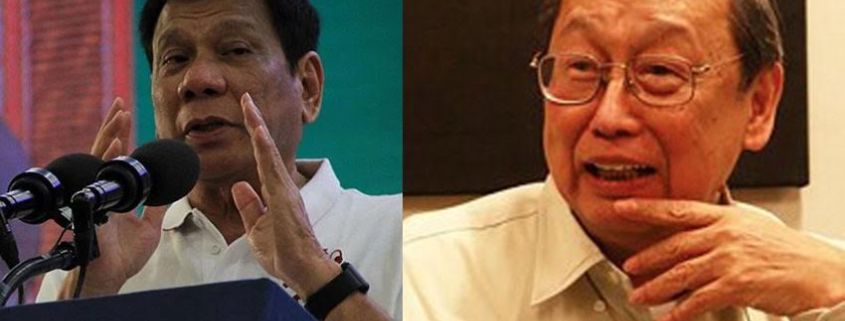
(Interview and Sison photo by Raymund B. Villanueva/Duterte photo by Davao Today)

xxxxx
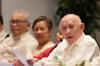
BINDING ONLY AFTER RELEASE, NDF now willing to sign bilateral truce before political prisoners’ release

lj-2016Published December 10, 2016 9:39pm
By ERWIN COLCOL, GMA News

The National Democratic Front (NDF) is now willing to sign a bilateral peace agreement with the government before the release of all political prisoners, an official of the communist group said Saturday.

“We are willing to sign it even ahead, but of course he (President Rodrigo Duterte) has to make a commitment and he has to implement it,” NDF adviser Luis Jalandoni told GMA News Online at the International Human Rights Day protest at the Liwasang Bonifacio in Manila.

“The NDFP will insist the release of political prisoners, [is] willing to sign a bilateral ceasefire, but Duterte has to release all political prisoners within 48 hours,” Jalandoni said. “And the agreement becomes binding and effective upon the release of all the political prisoners.”

The NDF is demanding the release of at least 400 political prisoners as part of the peace negotiations with the government.

The government has only released 21 rebel leaders since the peace talks with the NDF resumed.

The NDF said in a recent statement that “the release of political prisoners is not merely a goodwill measure but a matter of justice and compliance with the Comprehensive Agreement on Respect for Human Rights and International Humanitarian Law which both parties signed in 1998.”

Duterte said last Tuesday promised that he will release more political prisoners 48 hours after the NDF had signed a bilateral peace agreement with the government.

Duterte reiterated the statement on Thursday.

“I have conceded to the communists too much too soon. As yet, I have yet to see a substantive progress in the talks. They are asking for 130 detainees to be released… Sorry, I cannot do that,” Duterte said.

The government’s peace panel holding talks with the NDF had submitted a list of 200 prisoners to be releaed, under the new guidelines of the Presidential Committee on Bail, Recognizance and Parole (PCBREP).

Twenty-five of the political prisoners are elderly, sick and women.

The government and the NDF have standing unilateral ceasefires signed in August in Oslo, Norway.

The talks is scheduled to resume in Italy in January. —ALG, GMA News

NDFP STATEMENTS

On the ongoing talks
Julie De Lima, Chairperson of the NDFP Peace Negotiating Panel
National Democratic Front of the Philippines
September 4, 2024 | Peace Talks, Statements


NDFP National Council Responds to ATC Resolution No. 21
NDFP National Council
Press Statement
July 21, 2021


On the ATC Resolution Designating NDF as Terrorist
Press Statement by Jose Maria Sison
NDFP Chief Political Consultant
July 20, 2021


A Needless Nail on the Coffin of the GRP-NDFP Peace Negotiations
By Julieta Lima
Interim Chairperson, NDFP Negotiating Panel
July 19, 2021 Press Statement


CONDEMNATION OF THE MURDER OF RANDALL ECHANIS
By Jose Maria Sison
NDFP Chief Political Consultant
August 10, 2020

NDFP NEGOTIATING PANEL CAN RECOMMEND CEASEFIRE TO ITS PRINCIPAL IN RESPONSE TO THE CALL OF UN SECRETARY GENERAL FOR GLOBAL CEASEFIRE
By Jose Maria Sison
NDFP Chief Political Consultant
March 24, 2020

MILITARIST HAWKS SABOTAGE PEACE TALKS AND OPPOSE SOCIAL AND ECONOMIC REFORMS
REFERENCE: Julieta de Lima
Chairperson NDFP RWC-SER
January 14, 2020

Duterte regime continues to prevent peace negotiations and wage all-out war against the Filipino people
By Jose Maria Sison, NDFP Chief Political Consultant
11 January 2020

ON THE RESUMPTION OF THE GRP-NDFP PEACE NEGOTIATIONS
By Jose Maria Sison, NDFP Chief Political Consultant
December 9, 2019

NDFP CONDEMNS ARREST OF CASAMBRE COUPLE
Fidel V. Agcaoili
Chairperson, NDFP Negotiating Panel
December 7, 2018 Press Statement

SETTING THE RECORD STRAIGHT ON OUR ABORTED TRIP TO THE PHILIPPINES
Fidel V. Agcaoili
Press Statement
November 20, 2018

NDFP Panel welcomes House Resolution 1803 on resumption of peace talks
Fidel V. Agcaoili
Chairperson, NDFP Negotiating Panel
Posted 14 September 2018

GRP AND NDFP REPRESENTATIVES AGREE TO CONTINUE PEACE NEGOTIATIONS AND TO OVERCOME OBSTACLES AND IMPEDIMENTS
NDFP Press Statement
Utrecht, The Netherlands
June 20, 2018

‘Basic reforms must be the cornerstone of an interim peace agreement’
Reference: J de Lima
Chairperson, NDFP RWC-SER
Press Statement | May 28, 2018

THREAT OF NATIONWIDE MARTIAL LAW PERSISTS
By Jose Maria Sison, NDFP Chief Political Consultant
May 24, 2018

GRP-NDFP Negotations on CASER Is Key to Resolving Armed Conflict
NDFP International Information Office
April 4, 2018

ON THE RESUMPTION OF THE GRP-NDFP PEACE NEGOTIATIONS
By Prof. Jose Maria Sison, NDFP Chief Political Consultant,
March 27, 2018

On Duterte and His Parrot Roque
By Prof. Jose Maria Sison – NDFP Chief Political Consultant
Press Statement, January 17, 2018

RESPONSE OF PROF. JOSE MARIA SISON TO OFFER OF PRESIDENT DUTERTE
Press Statement
January 14, 2018

DUTERTE SCHEME OF FASCIST DICTATORSHIP
By Prof. Jose Maria Sison – Founding Chairman, CPP and Chief Political Consultant, NDFP
First published by TelesurTV on December 19, 2017

STATEMENT AGAINST PROCLAMATION 360 & 374 OF THE US-DIRECTED DUTERTE FASCIST REGIME
By Prof. Jose Maria Sison
Founding Chairman, Communist Party of the Philippines
Chief Political Consultant, National Democratic Front of the Philippines
December 10, 2017

NDFP awaits GRP’s written notice of termination
Negotiating Panel – National Democratic Front of the Philippines
24 November 2017

Duterte blocks progress of discussions on social and economic reforms
NDFP Media Release
23 November 2017

GRP unreasonable demands disrupt fifth round of talks
National Democratic Front of the Philippines
PRESS RELEASE, 27 May 2017
Noordwijk aan Zee, The Netherlands

Statement of the NDFP panel on the NPA as a target of martial law
National Democratic Front of the Philippines
26 May 2017

NDFP assails growing threats vs consultants, peace talks
NDFP Media Office | Press release
May 13, 2017

Utrecht Joint Statement
National Democratic Front of the Philippines
International Information Office
11 March 2017

On the Notice of Termination of the JASIG Sent on 07 February 2017 by Sec. Jesus Dureza
Fidel V. Agcaoili
Chairperson, NDFP Negotiating Panel
09 February 2017

Comprehensive Agreement on Socio-Economic Reforms Draft as of 17-01-12 (exchanged with GRP)

NDFP panel tells GRP panel that they could “talk while fighting”
NDFP Media Office
Press release
February 1, 2017

JOINT STATEMENT ON THE SUCCESSFUL THIRD ROUND OF FORMAL TALKS BETWEEN THE GRP AND NDFP IN ROME, ITALY
NDFP International Information Office
25 January 2017

Closing statement of NDFP Negotiating Panel Chairperson Fidel Agcaoili
by NDFP WebMedia
January 25, 2017

NDFP sees finished CASER draft this year
NDFP Media Office
Press release
January 24, 2017

Statement at Opening Ceremonies of Third Round of Talks in Rome
By Prof. Jose Maria Sison
Chief Political Consultant, National Democratic Front of the Philippines
Rome, 19 January 2017

Opening Speech For The Third Round of Talks in Rome
By Fidel V. Agcaoili
Chairperson, Negotiating Panel of the NDFP
19 January 2017
ndf-logo_smallIN UNITY WITH THE CPP’S CALL FOR PEOPLE’S EXPRESSION OF INDIGNATION OVER DUTERTE’S UNFULFILLED PROMISES IN PEACE NEGOTIATIONS
By Jose Maria Sison
Founding Chairman, Communist Party of the Philippines
Chief Political Consultant, National Democratic Front of the Philippines
December 26, 2016

ndf-logo_smallTHE PEOPLE SHOULD NOT RELENT IN DEMANDING JUSTICE FOR POLITICAL PRISONERS
Statement from NDFP peace panel chair Fidel Agcaoili
NDFP Media Office
December 5, 2016

20161129-death-b-ocasla_smallAnother death in detention, this time under Duterte regime’s watch

Negotiating Panel – National Democratic Front of the Philippines

tiamson-benito-free_smallTIAMZON SLAMS GRP DISINFORMATION ON BILATERAL CEASEFIRE
National Democratic Front of the Philippines
NDFP Media Office – Press Release
November 15, 2016

20161010-oslo-pax_smallSecond round ends with some progress but uncertainties remain
10 October 2016/in News /
NDFP Media Office | Press Release

ndf_flagNDFP CONDEMNS ILLEGAL ARREST OF NDFP CONSULTANT MARIA CONCEPCION “CONCHA” ARANETA-BOCALA
Luis Jalandoni
Chairperson, NDFP Negotiating Panel
02 August 2015

jmsSTOP HARASSING AND THREATENING LUIS JALANDONI, CHAIRPERSON OF THE NDFP NEGOTIATING PANEL
Press Statement by Prof. Jose Maria Sison
Chief Political Consultant of the NDFP Negotiating Panel
June 3, 2015

jmsAQUINO LACKS SINCERITY IN THE PEACE NEGOTIATIONS AND HAS WANTONLY VIOLATED EXISTING AGREEMENTS
By Prof. Jose Maria Sison
NDFP Chief Political Consultant in Peace Negotiations with the GPH/GRP
May 15, 2015

LJOn the CBCP President’s November 10 Message
By Luis Jalandoni
Chairperson, NDFP Negotiating Panel
Posted 16 November 2014

THE PEOPLE SHOULD NOT RELENT IN DEMANDING JUSTICE FOR POLITICAL PRISONERS

ndf-logo


National Democratic Front of the Philippines
Negotiating Panel

Statement from NDFP peace panel chair Fidel Agcaoili
NDFP Media Office
December 5, 2016


Lest the Office of the Presidential Adviser on the Peace Process (OPAPP) brand the National Democratic Front of the Philippines (NDFP) a temperamental brat, the NDFP reiterates its appreciation to President Rodrigo Duterte for exercising initiative and political will in effecting the release last August of 19 NDFP consultants and staff and enabling the peace negotiations to move forward.

That being said, there was also a clear understanding as early as May that the four remaining JASIG-protected persons held at the New Bilibid Prisons would soon be pardoned; that all the 400 plus political prisoners would walk free through general amnesty; and that the release of 130 sick and elderly political detainees would be prioritized for humanitarian reasons.

The Government of the Republic of the Philippines (GRP) likewise upheld all previously signed agreements, including the Comprehensive Agreement on Respect for Human Rights and International Humanitarian Law (CARHRIHL) which unequivocally defines the injustice underlying the continued detention of the political prisoners and the GRP’s obligation to rectify such injustice.

THREE MONTHS have passed since August, but NO OTHER political prisoners have been released through the peace process.

The NDFP takes exception to the OPAPP’s claim that freedom for political prisoners was “never possible nor even imaginable” under previous regimes and that the delays in their release have been due to the “processes (that) must be observed.” The truth is that there are many available modes that have already been used under the past regimes to release political prisoners, all in accordance with the GRP’s judicial processes.

It is a fact that once the President or other mandated or delegated authority so decides, a political prisoner can be released in a matter of days. OPAPP chief Jesus Dureza should be the first to know this, having been involved in the peace negotiations under previous administrations. The GRP peace panel members cannot feign ignorance about this either, since most of them are lawyers.

There is only one reason for the non-release: the political prisoners, including the sick and elderly, have been held hostage to pressure the NDFP into agreeing to a haphazardly drawn-up peace agreement that would redound to the revolutionary movement’s capitulation instead of addressing the roots of the armed conflict. Secretary Dureza’s threat to activists that “putting undue pressure on the government may not yield their intended results” has no other purpose than to insinuate that the GRP could drag its feet further or even scuttle the releases altogether if the people’s mass movement does not put a stop to its calls to free all political prisoners.

It is the NDFP that should be appalled at the utter bankruptcy of the GRP’s negotiating tactics which have already led to the death of Bernabe Ocasla, an elderly and ailing political prisoner whose long wait for justice ended tragically.

The families of political prisoners, human rights activists and advocates of just and lasting peace have every right to take to the streets and use other fora to protest and seek redress for grievances and denounce the GRP’s failure to comply with its obligation to give justice to the political prisoners. That is, unless Secretary Dureza is also implying that there is no more freedom of assembly and expression under the Duterte government.

###